 Jinan Alston Equipment Co.,Ltd.
Why Modern Breweries Choose High Gravity Brewing Systems?
As beer consumption continues to grow worldwide, breweries are constantly searching for ways to increase production without investing in larger brewhouses or additional fermentation tanks. One of the most successful technologies adopted by large commercial breweries—and increasingly by modern craft breweries—is High Gravity Brewing (HGB) combined with a precision beer dilution system.
But which beers are suitable for high gravity dilution? And what equipment is required to ensure the final beer maintains the same flavor and quality?
What Is High Gravity Brewing?
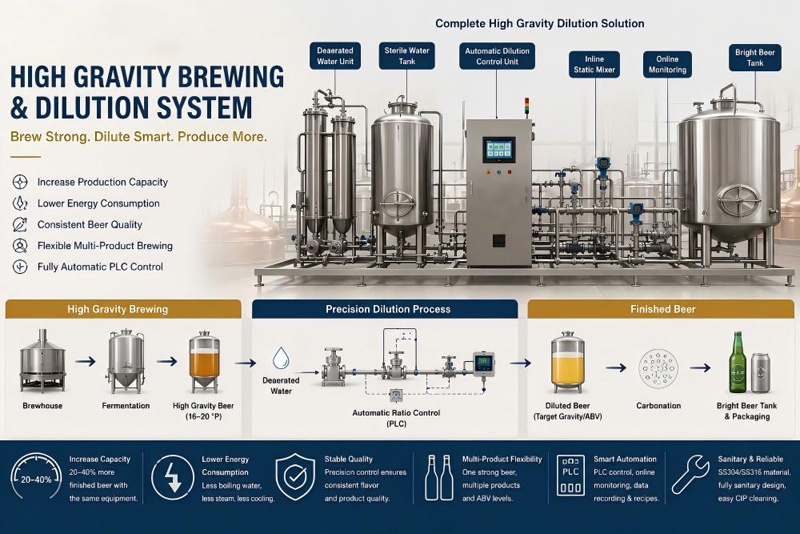
High Gravity Brewing (HGB) is the process of producing beer with a higher original extract (typically 16–20°Plato or higher) than the target finished beer. After fermentation and maturation, the concentrated beer is diluted with deaerated sterile brewing water until it reaches the desired alcohol content, bitterness, color, and extract level. This approach allows breweries to produce significantly more finished beer from the same brewhouse and fermentation capacity.
Instead of brewing 100 HL of 12°P lager, a brewery may produce 70 HL of 17°P beer and later dilute it to obtain approximately 100 HL of finished product.
Which Beer Styles Commonly Use High Gravity Dilution?
Not every beer style is ideal for dilution. The following products are the most common.
1. Standard Pale Lager
This is the most common application worldwide.
Examples include:
International Pale Lager
American Light Lager
Premium Lager
Pilsner (industrial production)
Large breweries producing millions of liters annually often brew one concentrated lager base and dilute it into several different alcohol levels.
Advantages:
Highest production efficiency
Excellent consistency
Reduced brewing costs
Easier inventory management
2. Light Beer
Light beers are perfect candidates because they require lower alcohol content.
Example:
A brewery may ferment beer at 6.0% ABV and dilute it to produce:
3.5% Light Beer
4.0% Session Beer
4.5% Standard Lager
Only one fermentation process is required.
3. Non-Alcoholic and Low-Alcohol Beer
Some breweries combine high gravity brewing with alcohol reduction technologies.
Benefits include:
Better body
Improved mouthfeel
Easier flavor adjustment
Higher process flexibility
4. Mass-Market Wheat Beer
Certain commercial wheat beers also utilize moderate high gravity brewing.
The dilution ratio is generally lower than that used for lager because wheat beers are more sensitive to body and aroma changes.
5. Session IPA
Many breweries brew a stronger IPA base before dilution to produce lower-alcohol Session IPA.
This method reduces brewing time while maintaining hop aroma. Additional dry hopping is often applied after dilution.
Which Beers Usually Do NOT Use High Gravity Dilution?
Premium craft beers are generally brewed at their final gravity because flavor complexity is the priority.
Examples include:
Imperial Stout
Barrel-aged Beer
Belgian Tripel
Belgian Quadrupel
Double IPA
Hazy IPA (many craft breweries)
Sour Beer
Specialty Fruit Beer
Although high gravity techniques can be applied, many craft brewers prefer traditional brewing to maximize aroma, body, and mouthfeel.
Why Large Breweries Prefer High Gravity Brewing?
For breweries operating above 50 HL per batch, the economic benefits are substantial.
Typical advantages include:
Increase Production Capacity
Existing fermenters can produce 20–40% more saleable beer, depending on the dilution ratio and brewery design.
Lower Capital Investment
Instead of purchasing additional:
Mash tuns
Lauter tuns
fermentation tanks
Bright beer tanks
Breweries simply install a precision dilution system.
Reduce Energy Consumption
Less wort needs to be boiled for the same finished beer output.
Steam consumption decreases.
Cooling demand decreases.
Cleaning water decreases.
Better Brewing Flexibility
One concentrated beer can become multiple products.
For example:
Base Beer ⇒ 5.5% Lager ⇒ Dilute to 5.0% ⇒ Dilute to 4.5% ⇒ Dilute to 3.8%
One fermentation can supply several different products.
What Equipment Is Required?
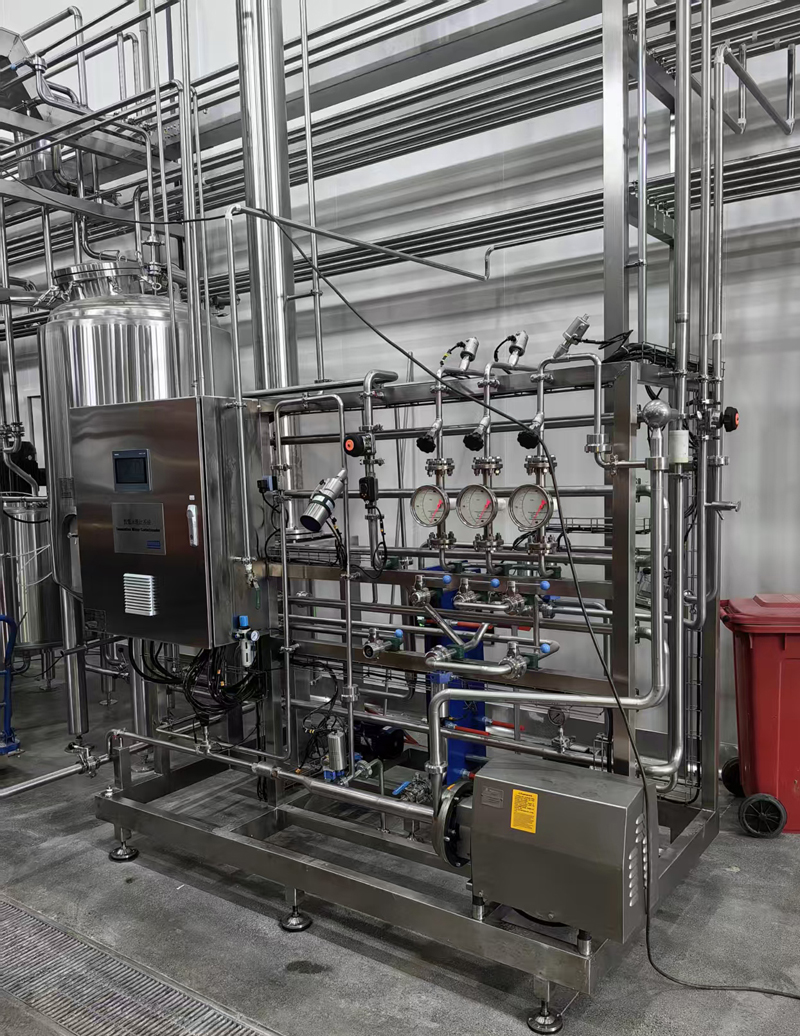
A complete High Gravity Dilution System usually includes:
1. Deaerated Water Unit
The dilution water must contain extremely low dissolved oxygen.
Typical DO level: <10 ppb
This protects beer flavor and shelf life.
2. Sterile Water Storage Tank
Maintains sterile brewing water before blending.
Features:
Sanitary design
CIP cleaning
Temperature control
Sterile vent filter
3. Precision Beer Dilution Unit
The heart of the system.
Functions include:
Automatic beer/water ratio control
Inline density measurement
Alcohol adjustment
Plato adjustment
Automatic recipe switching
4. Inline Static Mixer
Ensures perfect blending without introducing oxygen.
5. Online Monitoring Instruments
Including:
Density meter
Flow meter
Pressure sensor
Temperature sensor
Alcohol calculation
PLC automation
6. Carbonation Unit
Because dilution affects dissolved CO₂, the beer is normally carbonated after blending to achieve the target carbonation level.
7. Bright Beer Tank
After blending and carbonation, the finished beer enters the Bright Beer Tank before filtration or packaging.
Quality Control Is the Key
Successful high gravity brewing depends on precise control.
Important factors include:
Deaerated water quality
Accurate dilution ratio
Stable beer temperature
Oxygen control
Carbonation adjustment
Flavor consistency
PLC automation
Even a small increase in dissolved oxygen during dilution can significantly reduce beer freshness and shelf life.