 Jinan Alston Equipment Co.,Ltd.
How It Can Be Applied in Brewhouse Configurations for Decoction mashing ?
Decoction mashing is a traditional brewing technique with deep roots in Central European brewing history, particularly in German and Czech lager production. Unlike modern infusion mashing, decoction involves removing a portion of the mash, boiling it, and then returning it to the main mash. This process raises the mash temperature step by step without direct heating and promotes specific flavor, aroma, and body characteristics.
Historically, decoction mashing was developed to work with undermodified malts, but many modern brewers still use it today for its ability to enhance malt complexity, mouthfeel, and foam stability. Depending on the recipe, brewers may use single, double, or triple decoction, making process flexibility an important consideration when selecting brewhouse equipment.
Below, we explain how decoction mashing can be implemented in two-vessel, three-vessel, and four-vessel brewhouse systems, and what practical considerations apply to each configuration.
1.Decoction Mashing in a Compact 3 in 2 Vessel Brewhouse
A typical two-vessel brewhouse consists of:
* Mash/Kettle Tun
* Upper lauter / Lower Whirlpool
Although more compact in design, a two-vessel system can still support decoction mashing with proper planning.
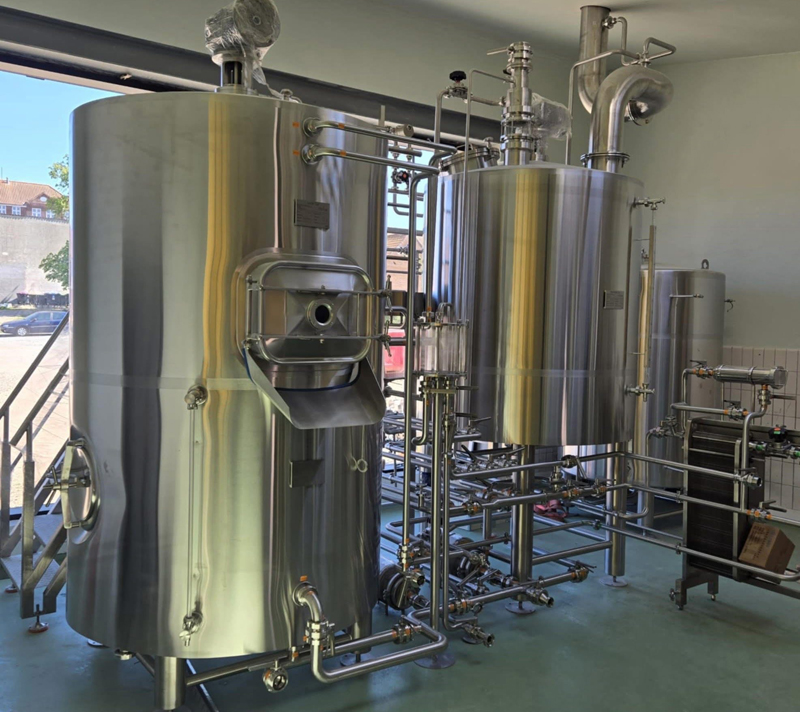
How It Works
- The mash is prepared in the Mash kettle Tun.
- A portion of thick mash (mainly grist with minimal liquid) is withdrawn through a side port positioned slightly.
- This mash portion is transferred to the Whirlpool Tun and wait.
- After boiling, the decoction is pumped back into the Mash/Lauter Tun to raise the mash temperature to the next rest.
Key Considerations
* An agitator in the kettle is strongly recommended to ensure even heating during boiling.
* The agitator can be designed as manually liftable to avoid interfering with whirlpool operation.
* Lautering and decoction operations must be carefully scheduled, as both processes share vessels.
2.Decoction Mashing in a Three-Vessel Brewhouse
A three-vessel brewhouse typically includes:
* Mash Tun
* Lauter Tun
* Kettle/Whirlpool Tun
This configuration offers greater flexibility and clearer process separation.
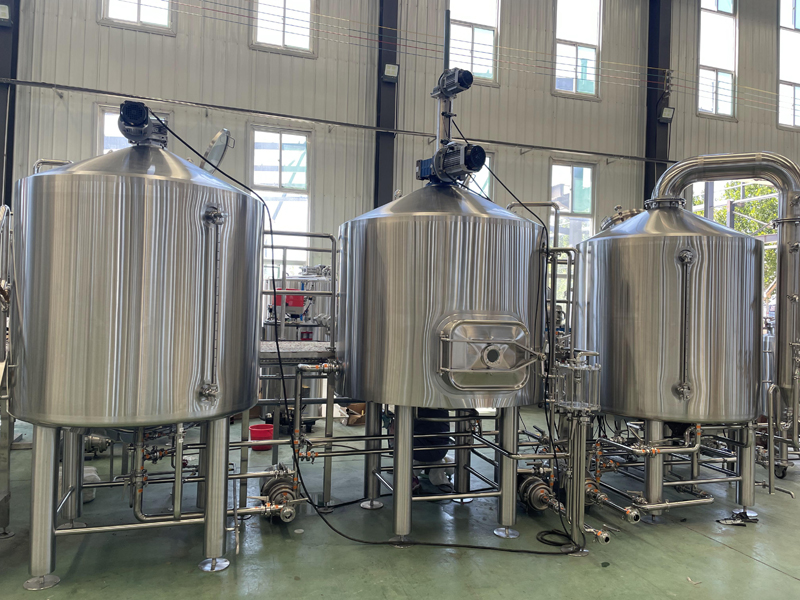
Three-Vessel Brewhouse
How It Works
- Mashing begins in the Mash Tun.
- A portion of the mash is transferred to the Kettle/Whirlpool Tun for boiling.
- The boiled decoction is returned to the Mash Tun to raise the mash temperature.
- Once mashing is complete, the mash is transferred to the Lauter Tun for separation.
Key Considerations
* The mash tun remains dedicated to mash rests, improving temperature stability.
* Decoction boiling does not interfere with lautering operations.
* Automated temperature control and pump sequencing can significantly reduce operator workload.
Three-vessel systems are well suited for single and double decoction mashing, offering a good balance between traditional brewing capability and operational efficiency.
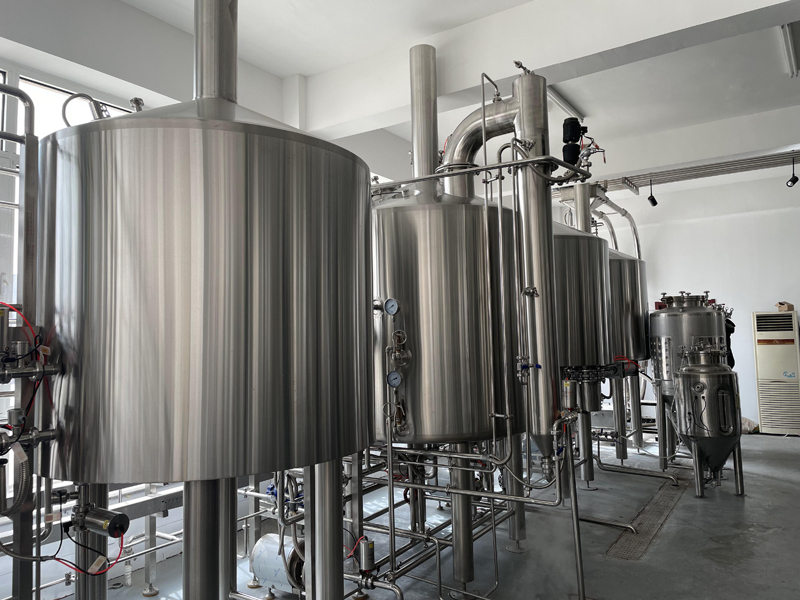
3.Decoction Mashing in a Four-Vessel Brewhouse
A four-vessel brewhouse typically consists of:
* Mash Tun
* Lauter Tun
* Kettle Tun
* Whirlpool Tun
This is the most flexible and professional configuration for decoction mashing.
Four-Vessel Brewhouse
How It Works
- Mash rests are performed in the Mash Tun.
- A portion of mash is transferred to the Kettle for decoction boiling.
- The boiled mash is returned to the Mash Tun to step up the temperature.
- Lautering, boiling, and whirlpooling all occur in dedicated vessels without overlap.
Key Considerations
* Allows single, double, and triple decoction with minimal process compromise.
* Highest level of process stability and repeatability.
* Ideal for breweries focusing on traditional lager styles or heritage brewing methods.
A four-vessel system provides maximum control, efficiency, and authenticity for decoction mashing, especially in medium to large-scale breweries.
4.Choosing the Right Configuration for Decoction Brewing
When selecting a brewhouse configuration, brewers should consider:
* Frequency of decoction mashing
* Desired level of automation
* Production capacity and scheduling
* Labor availability and process complexity
While decoction mashing can be adapted to all three configurations, three-vessel and four-vessel systems offer greater flexibility and efficiency, especially for breweries planning to use decoction as a core part of their brewing philosophy.
At Alston Equipment Co., we design brewhouse systems that support both modern infusion methods and traditional decoction processes. Our engineering team can customize vessel ports, agitators, piping, and control logic to ensure your brewhouse fully supports your brewing goals.
If you would like to explore decoction-compatible brewhouse designs for your brewery, feel free to contact us for technical consultation.